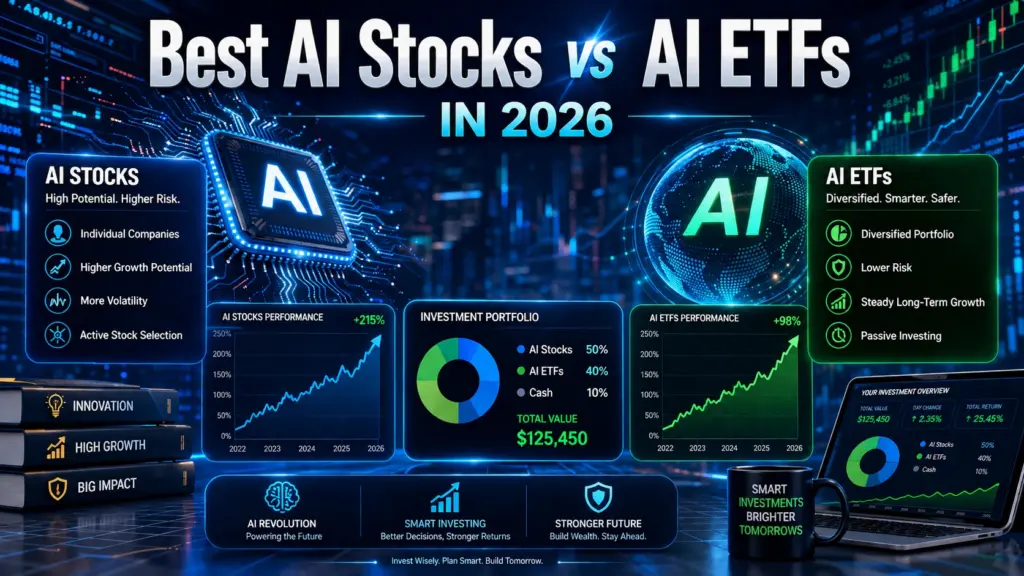
Artificial intelligence continues to reshape industries ranging from healthcare and finance to manufacturing and cloud computing. As AI adoption expands across the global economy, many investors are exploring ways to gain exposure to this rapidly growing sector. Two of the most common approaches are investing in AI stocks or choosing AI exchange-traded funds (ETFs).
Although both investment options provide access to companies involved in artificial intelligence, they work differently and involve different levels of risk, diversification, and potential returns. Choosing the right option depends on factors such as your investment goals, risk tolerance, time horizon, and experience.
This guide compares AI stocks and AI ETFs, explains how each investment works, highlights their advantages and potential risks, and discusses factors that long-term investors should consider before making investment decisions.
Disclaimer: This article is provided for educational purposes only and should not be considered financial or investment advice. All investments involve risk, including the possible loss of principal. Always conduct your own research or consult a qualified financial advisor before investing.
What Are AI Stocks?

AI stocks represent shares of publicly traded companies that develop or heavily rely on artificial intelligence technologies.
These businesses may operate in areas such as:
- Semiconductor manufacturing
- Cloud computing
- Machine learning software
- Robotics
- Data centers
- Enterprise AI solutions
- Autonomous vehicles
- Cybersecurity
Some companies generate most of their revenue directly from AI-related products, while others use artificial intelligence to strengthen existing businesses.
Because every company has a unique business model, financial performance can vary significantly between individual AI stocks.
How AI Stocks Work
When you purchase shares of an AI company, you become a partial owner of that business.
The value of your investment generally depends on several factors, including:
- Company earnings
- Revenue growth
- Product innovation
- Market competition
- Industry demand
- Economic conditions
- Investor sentiment
If the company performs well over time, its share price may increase. However, stock prices can also decline when business performance weakens, or market conditions change.
Advantages of AI Stocks
Investing in individual AI companies offers several potential benefits.
Some investors prefer AI stocks because they provide:
- Direct exposure to innovative companies
- Higher growth potential if a company performs well
- Voting rights for shareholders (where applicable)
- Opportunities to build a customised portfolio
- Greater flexibility in selecting specific businesses
For investors who research companies carefully, individual stocks may provide opportunities to outperform broader market indexes, although this is never guaranteed.
Potential Risks
While AI stocks may offer attractive growth opportunities, they also involve higher risk than diversified investment funds.
Common risks include:
- High share-price volatility
- Company-specific challenges
- Rapid technological changes
- Increased competition
- Regulatory uncertainty
- Premium market valuations
A single disappointing earnings report or product delay can sometimes affect an individual company’s stock price significantly.
For this reason, many investors choose to diversify rather than relying on only one AI stock.
What Are AI ETFs?
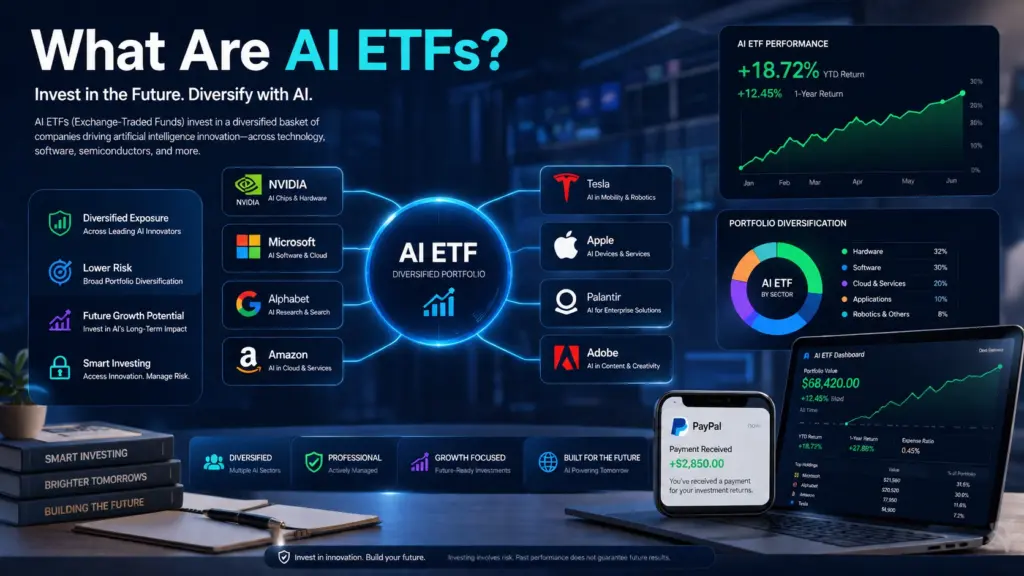
An AI ETF (Artificial Intelligence Exchange-Traded Fund) is an investment fund that holds a diversified collection of companies involved in artificial intelligence and related technologies.
Instead of purchasing shares of one company, investors buy a single ETF that may contain dozens—or even hundreds—of different stocks.
Depending on the fund, holdings may include companies involved in:
- Artificial intelligence software
- Semiconductor manufacturing
- Robotics
- Automation
- Cloud infrastructure
- Data analytics
- Autonomous technology
Because ETFs hold multiple companies, they generally provide broader exposure to the AI industry than investing in a single stock.
How AI ETFs Work
ETF providers create portfolios based on specific investment objectives or indexes.
When you purchase shares of an AI ETF, your investment is spread across all the companies included in that fund according to its allocation strategy.
This approach allows investors to gain diversified exposure through a single investment rather than buying each company individually.
Benefits of AI ETFs
Many long-term investors choose AI ETFs because they offer exposure to multiple companies through a single investment. Rather than depending on the performance of one business, an ETF spreads investments across several organisations operating in artificial intelligence, robotics, semiconductors, cloud computing, and automation.
This diversified approach can help reduce company-specific risk while still allowing investors to participate in the growth of the AI sector.
Diversification
One of the biggest advantages of an AI ETF is diversification.
Instead of buying shares in a single company, investors gain exposure to a portfolio that may include dozens of AI-related businesses across different industries.
Diversification helps reduce the impact if one company experiences financial difficulties or underperforms.
Lower Research Requirements
Researching individual companies requires time and a solid understanding of financial statements, competitive positioning, and industry trends.
AI ETFs simplify this process because professional fund managers or index providers determine which companies are included in the portfolio according to the fund’s investment strategy.
This makes ETFs attractive for investors who prefer a more hands-off approach.
Exposure to Multiple AI Industries
Artificial intelligence is much broader than software development.
Many AI ETFs include companies involved in:
- Semiconductor manufacturing
- Robotics and automation
- Cloud infrastructure
- Machine learning platforms
- Cybersecurity
- Data analytics
- Healthcare technology
This broader exposure allows investors to benefit from different areas of AI innovation instead of relying on a single business model.
Potential Risks of AI ETFs
Although AI ETFs reduce some risks associated with individual stocks, they still involve investment risk.
Market Risk
The value of an AI ETF may decline if the broader technology sector or stock market experiences a downturn.
Diversification reduces company-specific risk but cannot eliminate market-wide losses.
Limited Upside from Individual Winners
When one company experiences exceptional growth, its impact on an ETF may be limited because the fund holds many different companies.
Investors seeking maximum exposure to a specific company may prefer individual stocks instead.
Expense Ratios
Most ETFs charge an annual management fee known as an expense ratio.
Although many ETFs have relatively low fees, investors should compare costs before investing because fees may affect long-term returns.
AI Stocks vs AI ETFs: Key Differences
Choosing between AI stocks and AI ETFs depends on your investment strategy, experience, and risk tolerance.
| Feature | AI Stocks | AI ETFs |
| Diversification | Low (single company) | High (multiple companies) |
| Risk Level | Higher | Generally lower |
| Research Required | Extensive | Moderate |
| Potential Return | Higher potential but higher risk | More balanced growth potential |
| Volatility | Usually higher | Usually lower |
| Suitable For | Experienced investors | Beginners and long-term investors |
| Management Fees | None (brokerage fees may apply) | Annual expense ratio |
Neither option is universally better. The right choice depends on your personal financial goals and investment strategy.
Top AI Stocks to Watch in 2026
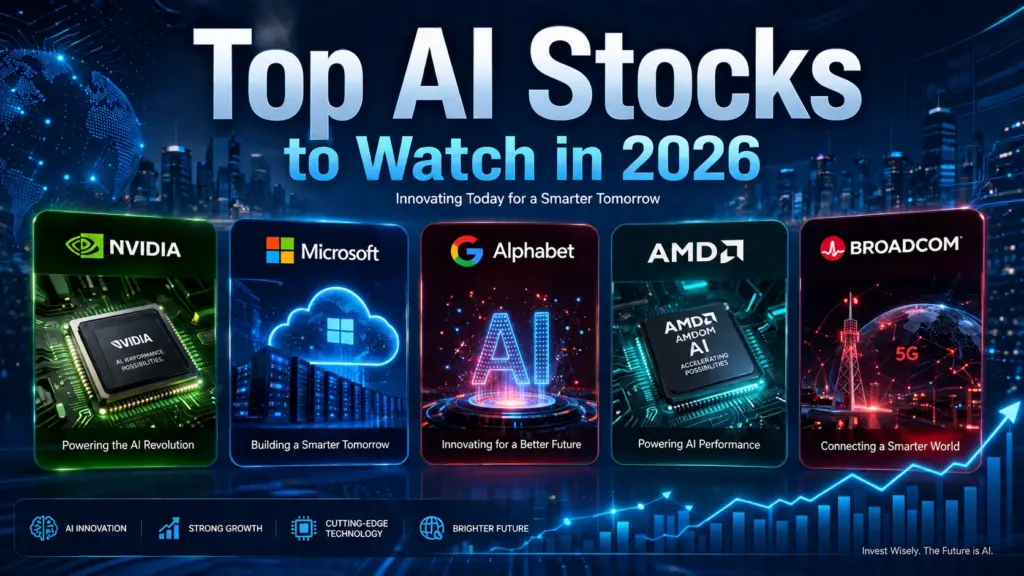
Several large technology companies continue to play important roles in the development of artificial intelligence.
Below are examples of companies that investors frequently monitor. Their inclusion here is not a recommendation to buy or sell securities.
NVIDIA
NVIDIA designs graphics processing units (GPUs) that are widely used for AI training, cloud computing, and data centres.
The company has become a major supplier of hardware supporting modern artificial intelligence applications.
Microsoft
Microsoft has expanded its AI capabilities through investments in cloud computing, productivity software, and enterprise AI solutions.
Its Azure cloud platform continues to support businesses adopting artificial intelligence technologies.
Alphabet
Alphabet, the parent company of Google, continues to invest heavily in machine learning, cloud computing, AI-powered search, and research initiatives.
Artificial intelligence plays an increasingly important role across many of its products and services.
Broadcom
Broadcom develops semiconductor and infrastructure software solutions used in networking, cloud computing, and enterprise technology.
Its products support growing demand for high-performance computing infrastructure.
AMD
Advanced Micro Devices (AMD) develops processors and accelerators used in data centres, AI workloads, gaming, and enterprise computing.
The company continues to expand its presence in high-performance computing markets.
Popular AI ETFs in 2026
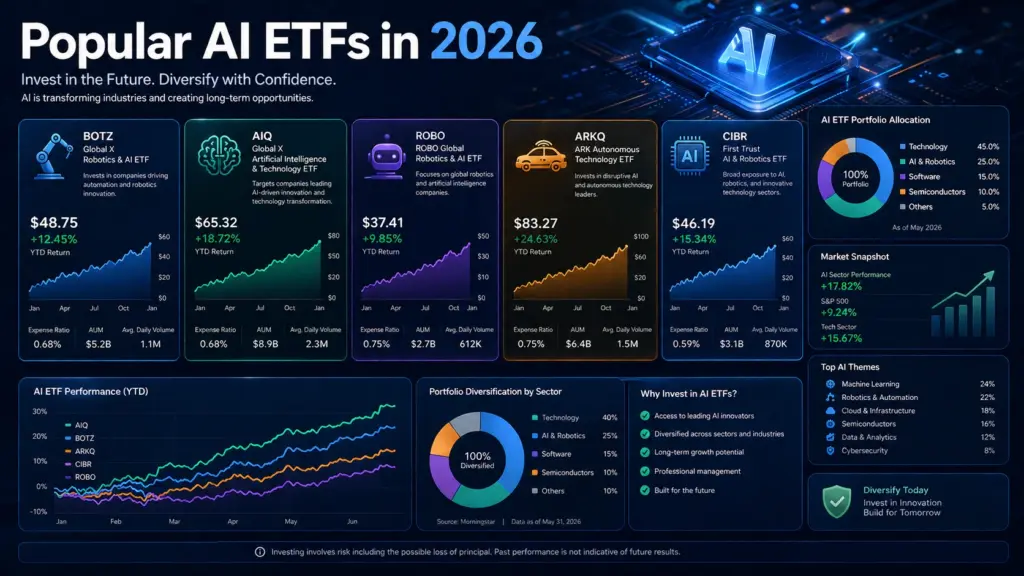
Investors interested in diversified AI exposure often research specialised technology ETFs.
Some widely followed examples include:
Global X Artificial Intelligence & Technology ETF (AIQ)
This ETF focuses on companies involved in artificial intelligence, machine learning, cloud computing, and big data technologies.
Global X Robotics & Artificial Intelligence ETF (BOTZ)
BOTZ invests primarily in companies involved in robotics, industrial automation, and artificial intelligence technologies.
ROBO Global Robotics and Automation Index ETF
This fund provides exposure to businesses involved in robotics, automation, sensing technology, and intelligent systems across multiple industries.
ARK Autonomous Technology & Robotics ETF (ARKQ)
ARKQ invests in companies associated with autonomous technology, robotics, energy storage, space exploration, and artificial intelligence innovation.
Which Option Is Better for Beginners?
For many new investors, deciding between AI stocks and AI ETFs can feel overwhelming. The best choice depends on your financial goals, investment experience, and comfort with market fluctuations.
Beginners who prefer a simpler approach may find AI ETFs easier to understand because a single investment provides exposure to multiple companies. Investors who enjoy researching businesses and following financial news may prefer selecting individual AI stocks.
Neither approach guarantees better returns. The key is choosing an investment strategy that matches your long-term objectives and risk tolerance.
AI ETFs May Be Suitable for Beginners
Many financial educators recommend diversified investments for people who are just starting because diversification may help reduce company-specific risk.
Potential advantages include:
- Exposure to multiple AI companies
- Lower impact if one company underperforms
- Simpler portfolio management
- Professional or index-based fund management
- Easier long-term investing approach
Although ETFs reduce concentration risk, their value can still rise or fall with the market.
Individual AI Stocks May Suit Experienced Investors
Some investors prefer building portfolios using individual companies because it provides greater control over investment decisions.
Investors choosing individual AI stocks should be prepared to evaluate factors such as:
- Revenue growth
- Profitability
- Competitive advantages
- Debt levels
- Product innovation
- Valuation
- Industry competition
Research becomes especially important when investing in rapidly evolving technology companies.
How to Build a Balanced AI Investment Portfolio
Artificial intelligence is one of many sectors within the broader stock market. Concentrating too much of a portfolio in one industry may increase overall risk.
Many long-term investors choose to diversify across different asset classes and sectors.
A balanced portfolio might include:
- Broad market index funds
- AI ETFs
- Selected AI stocks
- Dividend-paying companies
- International investments
- Bonds or fixed-income investments (depending on personal goals)
Diversification cannot eliminate investment risk, but it may help reduce the impact of poor performance in any single investment.
Review Your Risk Tolerance
Before investing, consider questions such as:
- How long do you plan to invest?
- Can you tolerate short-term market declines?
- Are you investing for retirement or shorter-term goals?
- How much volatility are you comfortable accepting?
Your answers can help determine whether individual stocks, ETFs, or a combination of both better fits your investment strategy.
Important Factors to Consider Before Investing
Artificial intelligence continues to develop rapidly, but investment decisions should always be based on careful research rather than market excitement alone.
Consider evaluating the following factors before investing.
Company Fundamentals
For individual AI stocks, review information such as:
- Revenue growth
- Earnings performance
- Free cash flow
- Balance sheet strength
- Competitive position
- Management quality
Strong financial fundamentals often provide a clearer picture of a company’s long-term potential.
ETF Holdings
Before purchasing an AI ETF, review:
- Top holdings
- Sector allocation
- Geographic exposure
- Expense ratio
- Investment objective
- Rebalancing strategy
Different AI ETFs may have significantly different portfolios even though they share similar names.
Valuation
Popular technology companies sometimes trade at higher valuations due to strong growth expectations.
Higher valuations do not necessarily mean an investment is poor, but they may indicate higher expectations and increased sensitivity to disappointing results.
Investors often compare valuation metrics with earnings growth, revenue trends, and broader market conditions before making decisions.
Risk Management Strategies
Every investment involves risk, including investments focused on artificial intelligence.
Some commonly discussed risk management practices include:
Diversify Investments
Avoid concentrating all investments in a single company or industry.
Diversification across sectors may help reduce portfolio volatility over time.
Invest Regularly
Some investors use dollar-cost averaging, investing fixed amounts at regular intervals regardless of short-term market movements.
This approach may reduce the impact of market timing, although it does not guarantee profits or protect against losses.
Maintain a Long-Term Perspective
Technology sectors often experience periods of significant volatility.
Long-term investors typically focus on business fundamentals and broader investment objectives rather than reacting to short-term price movements.
Common Mistakes Investors Should Avoid
Many investment mistakes occur because of emotions rather than research.
Examples include:
Chasing Market Hype
Rapid price increases can attract attention, but investment decisions should be based on careful analysis rather than excitement alone.
Ignoring Diversification
Investing all available capital in one AI stock increases concentration risk.
Diversifying investments may help improve long-term portfolio stability.
Overlooking Fees
Expense ratios, trading costs, and taxes can affect long-term investment performance.
Understanding these costs is an important part of investment planning.
Investing Without Research
Whether choosing individual stocks or ETFs, investors should understand:
- What the company or fund does
- How it generates revenue
- Potential risks
- Long-term business outlook
Well-informed decisions are generally stronger than decisions based solely on headlines or social media discussions.

Conclusion
Artificial intelligence continues to influence industries across the global economy, creating new opportunities for businesses and investors alike. As interest in AI grows, both AI stocks and AI ETFs have become popular ways to gain exposure to this innovative sector.
Individual AI stocks may appeal to investors who are comfortable researching companies and accepting higher levels of risk in pursuit of potentially greater returns. AI ETFs, on the other hand, provide diversified exposure across multiple companies, making them an option many long-term investors consider when seeking broader participation in the AI industry.
Neither investment approach is universally better. The most suitable choice depends on your financial goals, investment timeline, experience, and ability to manage market volatility. Before making any investment decisions, take time to research companies or funds carefully, understand the associated risks, and ensure your portfolio remains diversified.
Artificial intelligence is expected to remain an important area of technological development for years to come. Still, successful investing requires patience, discipline, and a long-term perspective rather than reacting to short-term market movements.
Frequently Asked Questions (FAQs)
Are AI ETFs better than AI stocks?
AI ETFs and AI stocks serve different investment objectives. AI ETFs provide diversified exposure across multiple companies, while individual AI stocks concentrate investment in a single business. The better choice depends on an investor’s financial goals, research ability, and risk tolerance.
Which AI ETF is the best?
There is no single AI ETF that is suitable for every investor. Before investing, compare each fund’s investment objective, holdings, expense ratio, diversification, and long-term strategy to determine whether it aligns with your goals.
Should beginners invest in AI ETFs?
Some beginners prefer AI ETFs because they provide diversification through a single investment. However, every investment involves risk, and individuals should understand a fund’s objectives and risks before investing.
What are some widely followed AI stocks?
Companies frequently discussed within the artificial intelligence sector include NVIDIA, Microsoft, Alphabet, AMD, and Broadcom. Their future performance depends on business fundamentals, market conditions, and many other factors.
Is NVIDIA considered a long-term investment?
Many investors monitor NVIDIA because of its role in AI hardware and data centre technology. Whether it is appropriate for a long-term portfolio depends on an individual’s financial goals, valuation considerations, and risk tolerance.
Are AI stocks overvalued?
Valuation depends on each company’s financial performance, growth expectations, earnings, and market conditions. Investors often compare valuation metrics with long-term business fundamentals rather than relying solely on share price movements.
How do AI ETFs work?
AI ETFs invest in a collection of companies involved in artificial intelligence and related technologies. Investors purchase shares of the ETF rather than buying each company individually, providing diversified exposure through a single investment.
Which is generally considered less risky: AI stocks or AI ETFs?
Because AI ETFs typically hold multiple companies, they may reduce company-specific risk through diversification. However, both ETFs and individual stocks remain subject to market risk and can lose value.
Official Sources
- U.S. Securities and Exchange Commission (SEC)
https://www.sec.gov/ - Investor.gov
https://www.investor.gov/ - Nasdaq
https://www.nasdaq.com/ - New York Stock Exchange (NYSE)
https://www.nyse.com/ - Global X ETFs
https://www.globalxetfs.com/ - BlackRock iShares
https://www.ishares.com/ - Vanguard
https://investor.vanguard.com/ - ARK Invest
https://ark-invest.com/
Internal Linking Suggestions
- Stock Market Today: Top AI Stocks Set to Surge in 2026
- Best Personal Finance Tips for Beginners
- Personal Finance Money Management in 2026
- Best Passive Income Ideas in USA 2026
- How to Raise Credit Score Fast
About the Author
Mehul Patel is the founder of Solvibex.com and writes educational content on investing, personal finance, artificial intelligence, and digital technology. His articles simplify complex financial topics through well-researched, reader-friendly guides designed to help users make informed decisions.
Disclaimer
This article is intended for educational and informational purposes only. It does not constitute financial, investment, legal, or tax advice. Investments in stocks and exchange-traded funds involve risk, including the possible loss of principal. Always conduct independent research and consider consulting a qualified financial advisor before making investment decisions.